
The pedestrianisation of the Narroway was an obvious improvement for both pedestrians and bus journey times so in June 2013 all buses were removed from the Narroway and diverted to use the same route northbound buses used; via Dalston Lane and Amhurst Road. Cycling was also permitted along the street in both directions but in order to prevent cyclists from "owning" the roadspace it was redesigned to ensure it was clear this was "shared space"
 |
| A photo I took of the Narroway in 2013, shortly after the buses had been removed, you can see how narrow the pavements were, with the space on the right a loading bay for deliveries |
 |
| Image taken from the architecture practice who designed the temporary layout |
A total of 8% of respondents to the consultation expressed concern at the risk of conflict between people walking and cycling in the new layout, this was the highest concern of all responses. Hackney Council claimed in late 2015 that there had been no reported collisions between people cycling and walking since the start of the trial in 2013. I really want to thank Hackney Council for making the sensible decision to allow cycling on the Narroway and taking an evidence based approach to this decision
 |
| A high street in Northampton, typical of many pedestrianised high streets in the UK that do not allow cycling. Since I took this picture part of this street has had the pedestrianisation removed to allow motor vehicles to return |
 |
| Nijmegen |
 |
| Zwolle |
The Narroway was also initially planned to have a similar layout, to reduce conflict between people walking and cycling
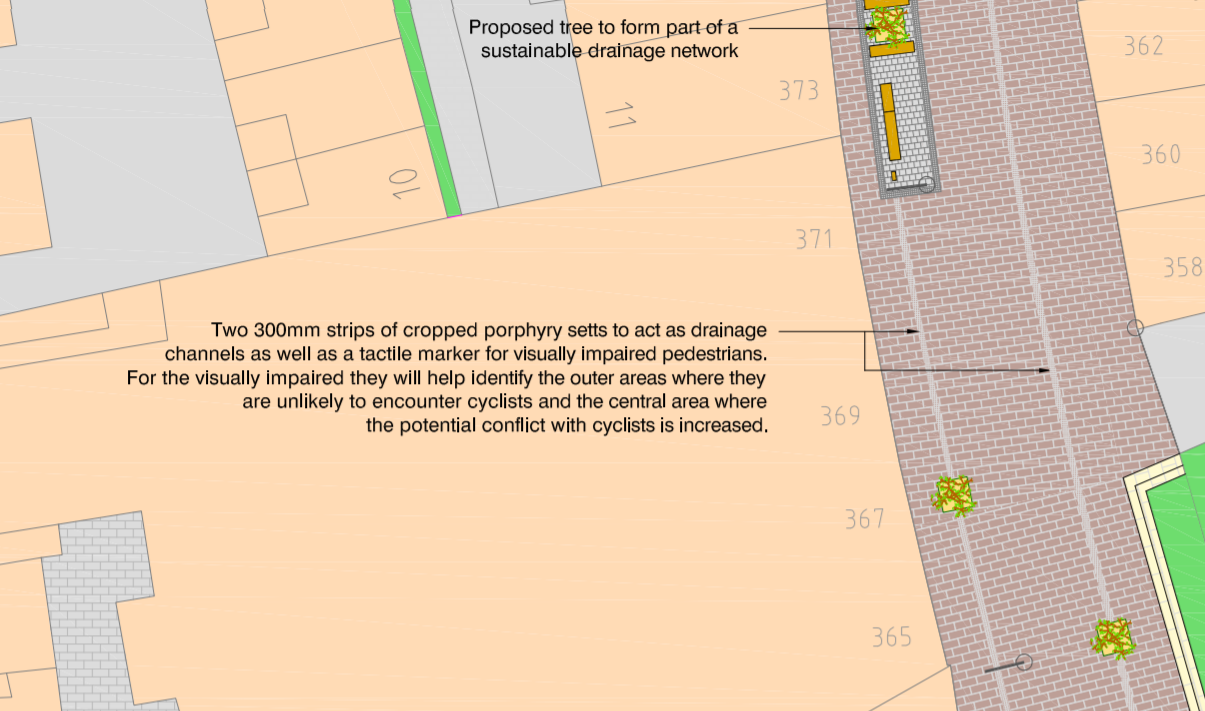
However the Royal National Institute of Blind people stated that they did not support the tactile strips, instead calling for detectable kerbs to separate the "cycle lane from the footway". The council agreed to remove these strips and any features that may resemble cycle lanes from the scheme, with the road designated a "Pedestrian Zone" which allowed considerate cycling. The scheme was budgeted at £3.25m, with nearly £2m supplied by TfL, just over £1m from the council and the rest via S106 agreements. Reconstruction began in January 2017 and was meant to last for a year but hit delays and took until late 2018 before it was fully completed
 |
| Reconstruction underway in 2017 |

Southbound the street is signed as a pedestrian and cycle only zone, except for loading between 6pm and 10am. There are no loading bays marked on the street with local retailers asked to observe considerate parking when loading
 |
| Entering the street Southbound |

The cycle parking is well used, although I'm not personally keen on the steel designs and would have preferred traditional cycle stands

Catenary lights have been used, suspended from wires attached to the buildings either side of the street to avoid the need to use poles
 |
| Catenary wire systems are also often seen in the Netherlands to hold lights and tram wires on main roads in cities, leaving more space on the carriageway for cycling infrastructure |
It's a really lovely street to walk, cycle and sit to have lunch on now, much improved from the bus clogged place it used to be, and certainly a huge upgrade from the gyratory days of the 1970s!

 |
| The Narroway in 1975 and 2019 |

although this meant that it was illegal for people cycling to use this crossing, although there was really no other choice. Thankfully within a few months this was changed and the crossing became a toucan crossing

The new toucan crossing allows people to cycle onto the footway on the other side and then up Clarence Road, which is a fairly quiet road to cycle on, due to all streets to the west of it filtered to through motor traffic at Pembury Road and a left turn only onto Lower Clapton Road, forcing drivers coming from the top of Clarence Road or from Lower Clapton Road back in the direction they have just come from. This means that Clarence Road is not a useful through route for cars and only really serves as an access road to the streets leading off it. It does however serve as a popular cycling route from Hackney Downs to the Narroway due to its directness and quietness.
This woman brought a smile to my face today. #schoolrun #bikingwithkids #hackney @hackney_cycling pic.twitter.com/VWuKs7A4Yt— Tab (@mum_on_bike) 16 November 2018
Unfortunately it is still illegal to cycle up Clarence Road from the Narroway, as a clear "no entry " sign demonstrates. The plan outlined in the consultation was for a "No entry except cyclists" sign to replace it but nearly three years on from the beginning of the scheme construction and a year after it was completed this has still not yet happened for some reason. There are also no signs to indicate the pavement at the bottom of Clarence Road is shared but surely as it is a toucan crossing it must be. Perhaps a short bidirectional cycle track from Clarence Road to the crossing and a clearly marked bicycle and pedestrian crossing, as there is on Hackney road at Columbia road, might have been better.
Cyclist should avoid riding on the pavement unless marked as shared with pedestrians, but remember to always give pedestrians priority! #CyclinginHackney pic.twitter.com/0vIsZ1nc6b— Hackney Council (@hackneycouncil) August 23, 2019
The wide toucan crossing is a vast improvement on the staggered crossing that it replaced, however the new central strip on Dalston Lane forces cyclists into primary position on a very busy road and one of Hackneys busiest bus routes. The space here could have been used for protected cycle tracks instead.
Dalston Lane has changed a lot in recent years, due to the Pembury Circus / Atkins Square development on the north side of the road, which has delivered over 200 new homes, a new supermarket, a cafe and a community centre, where the Hackney cycling campaign hold their monthly meetings. As part of this development the footway was extended and is now gigantic all the way from Pembury Circus to the Narroway

A rather wasteful use of the space available when right alongside people are expected to cycle on a narrow road either in the doorzone of parked cars or on a very badly surfaced road. This road is used by over a hundred buses an hour at peak times and over 10,000 motor vehicles everyday which means families in the new development have no safe way to cycle to the Narroway, although in reality most will simply cycle on the huge footway instead.
 |
| Five years on from Hackney Council declaring that they want their roads to be the safest roads for cycling in the UK, where it is second nature for anyone, no matter what their age to cycle. Dalston Lane certainly isn't somewhere where that can happen |
A better use of the space would have been a bidirectional cycleway linking Pembury Circus with the Narroway, whilst still leaving ample space for pedestrians, trees and street furniture
 |
| It's better to make the roads safer for everyone |

Once through the green light you'll then have to manoeuvre across into the second lane as the lane you're in is for left turning traffic only. Often this will involve using lane one until you get to the lights at Morning Lane, only to then try and swing right into the ASL, assuming it isn't blocked. I've downloaded a couple of TfL traffic camera clips from one recent morning rush hour below to show a typical example of this
It may not surprise you the hear I've never once seen a child cycling to school at during the rush hour here!
 |
| The traffic lights are on red at the Mare Street / Morning Lane junction as I took this photo. The ASL is almost completely blocked by a bus and two cars. Would you filter through that queue of cars and lorries with your family on bikes here? |

Cycling south from Reading Lane to the Narroway isn't much better, or possibly even worse. If you scroll up to the top of this page you'll see my header image is a picture of this road, a shared bus lane on a road six lanes wide. Once though the Morning Lane lights you can then use the left hand lane to go ahead, rather than being forced to manoeuvre into lane two, but often you're either sandwiched between traffic or will have to brave it and filter through

Before you get to the Narroway where you want to turn right into it

If you're lucky the pedestrian crossing will be on red round the corner, giving you a clear chance to do so. Often though it won't so you either block the road waiting to turn right, and get honked at, or wait in the middle of the road with buses passing close by on both sides of you

Cycling through Hackney Central is for the brave few, and certainly not for the many. Last week I saw this family cycling along the fantastic new Narroway, perfectly safe and chatting away with each other

To be fair to them, when they got to the bottom of the Narroway they waited and then carefully made their way up Mare Street cycling in the carriageway. Then they got to Graham Road and a wall of motor traffic greeted them where they, understandably, crossed over the pedestrian crossing and continued up to the Hackney Grove cycleway by cycling considerately on the pavement. Who can blame them? Cycling with your family on the road here is frankly not safe and I would never do it.

The other issue is that Mare Street is also a destination for families, with the Picturehouse cinema holding family screenings at the weekend and the Hackney Empire regularly often featuring shows for children. It makes sense for some local families to arrive here by bike but they are really left with little option but to use the pavement

Give these families a safe route through Hackney Central and they won't be cycling on the pavement. The present layout is simply not safe enough and is one of the worst locations for cycling collisions in the borough
Cyclist, 20, fighting for life after crash in Hackney this morning https://t.co/TyoHKUz7qz pic.twitter.com/jakDAGScyL— Evening Standard (@standardnews) 15 October 2016
It was very disappointing that a few years ago the local police announced that pavement cycling was the priority crime that they would be dealing with
A successful ward meeting tonight. The ward priority is set to tackle anti - social cycling on pavements. Next meeting 20th May. Venue TBC— Hkney Central Police (@MPSHackneyCentr) 4 February 2015
Yes, pavement cycling is annoying but lets focus on the real danger here, which is people walking and cycling being inured or killed by motor traffic.
 |
| A pavement on Mare Street in Hackney Central. Is pavement cycling really the issue here? |
If you want to stop people cycling on the pavement in Hackney Central then providing safe conditions for them to cycle is the clear solution. This solution was presented to Hackney Council back in 2015 when Andrew Gillian was the cycling commissioner and Quietway 2 was planned to go via the most obvious route, linking the Hackney Grove cycleway and the Narroway
 |
| Option 1 - a bidirectional cycle track running along the western side of Mare Street, linking Reading Lane with the Narroway and finally making Hackney Central a place that is safe enough for anyone to navigate on a bike. Option 2 was stepped cycle tracks running on either side of the road |
 |
| Hackney Council in their 2015-2025 cycling plan |
The future of Hackney Central - have your say
Two years ago Hackney Council received £10m in funding to finally introduce protected cycle tracks on Mare Street in Hackney Central, redesign the Pembury Junction and make Amhurst Road, which runs between the two, a through route for buses only.
 |
| Amhurst Road is already four lanes wide so with a bus gate protected cycle tracks can easily be accommodated. Bus priority is achieved without the need for bus lanes, because the private motor traffic will have been removed |
As well as submitting your comments on moving through Hackney Central you can also add comments to a map, which covers a wider area. Perhaps you'd like to see Chatham Place filtered on Q2 or modal filters on the Naverino Road cycle route? Perhaps the contraflow cycle track on Paragon Road should be made bi-directional and run all the way from Mare Street to Morning Lane to link the proposed cycle tracks on Mare Street with the recently constructed cycle track on Wick Road?

If you live, work, shop or travel through Hackney Central then please do let the council know what changes you'd like to see to the roads and junctions that would enable families to get about by bike and ensures that the safety of people walking and cycling comes first.


